Insights, Events and Videos
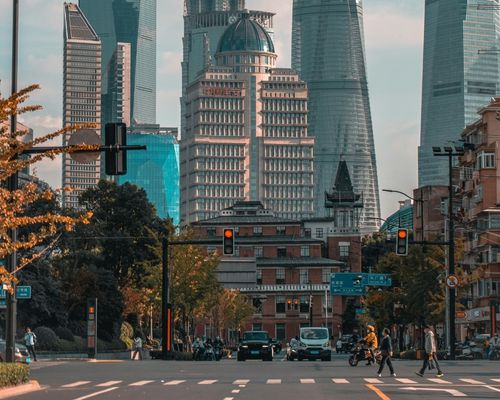
From Paying Claims to Preventing Crashes: Ping An Uses AI to Make City Traffic Safer
In megacities, traffic safety is not only a matter of road management. It is also a matter of risk management.
As urban populations grow and mobility patterns become more complex, intersections near elevated roads, tunnels and major transport hubs often present hidden risks. Visual blind spots, mixed traffic flows, and high volumes of pedestrians, cyclists and vehicles can increase the likelihood of dangerous behavior and accidents.
To address these challenges, an AI-powered Urban Traffic Risk Warning System has recently been put into regular operation in Huangpu District, Shanghai. The system was jointly developed by the Huangpu police and Ping An Group, among other partners. It is the first of its kind in China to focus on managing blind-spot risks at elevated road intersections.
The project is located at the intersection of Huangpi South Road and Yan’an East Road, a busy area in the heart of Shanghai, close to People’s Square and an entrance and exit of the Yan’an Elevated Road. Elevated-road pillars can obstruct the view for pedestrians and cyclists when they cross the intersection, increasing the risk of entering restricted areas, moving against traffic or crossing dangerously.
Conventional measures, including active traffic management and road design adjustments, did not fully address the risks. The challenge was not only the road layout, but also dynamic behavior in a complex traffic environment. This made real-time risk detection and immediate intervention essential.
The new AI warning system is designed to detect these risks in real time and intervene before an accident occurs.
By integrating millimeter-wave radar, high-definition cameras, edge computing and AI-based risk identification models, the system can monitor the dynamic traffic environment at the intersection with high precision. Ground-projected guidance lights help direct pedestrians, cyclists and vehicles to safer routes. When the system detects a pedestrian or non-motorized vehicle entering a blind-spot area or engaging in risky behavior, it immediately triggers audio and visual alerts, including directional voice reminders, to guide the person away from danger.
During a two-month pilot period, the number of non-motorized vehicles entering the elevated-road area declined noticeably, and the traffic accident rate at the intersection was significantly reduced. The system has helped improve road safety, enhance traffic order and strengthen safety for citizens’ daily travel.
For Ping An, the project represents more than a single technology application. It reflects a broader shift in the role of insurance from post-event compensation to proactive risk reduction.
Traditionally, insurance has been associated with claims payment after losses occur. Today, with the support of data analytics, artificial intelligence and scenario-based risk management, insurers can play a more active role in identifying risks, preventing losses and supporting safer communities. By combining claims data, risk recognition models and intelligent sensing hardware, Ping An is helping move urban traffic management from “response after the event to “prevention before the event” and “intervention during the event.”
The Shanghai project also marks an important extension of Ping An’s “Traffic Light” road safety risk reduction initiative. Since its launch in April 2025, the initiative has supported improvements at 1,789 high-risk road sections in 303 counties across 31 provinces, autonomous regions and municipalities in China. More than 10,000 sets of traffic safety facilities have been deployed. Building on this experience, Ping An is now extending its risk reduction capabilities from rural road infrastructure upgrades to AI-enabled urban traffic governance.
As cities continue to modernize, the ability to reduce risk before losses occur will become increasingly important. Through AI, data and integrated financial and insurance capabilities, Ping An is working with public-sector and ecosystem partners to build safer roads, smarter cities and more resilient urban mobility systems.